Fundamentals
Remote Design Critiques Make the Distance Useful
A practical way to choose sync, async, or both—then turn scattered comments into a decision the team can follow.

The short read
Frame the decision
Share the artifact, audience, stage, constraints, and question before asking anyone to comment.
Separate seeing from discussing
Give people a quiet first pass so the first confident voice does not become the whole critique.
Record what happens next
Sort feedback into change, investigate, keep, and outside scope—then name the owner and next check.
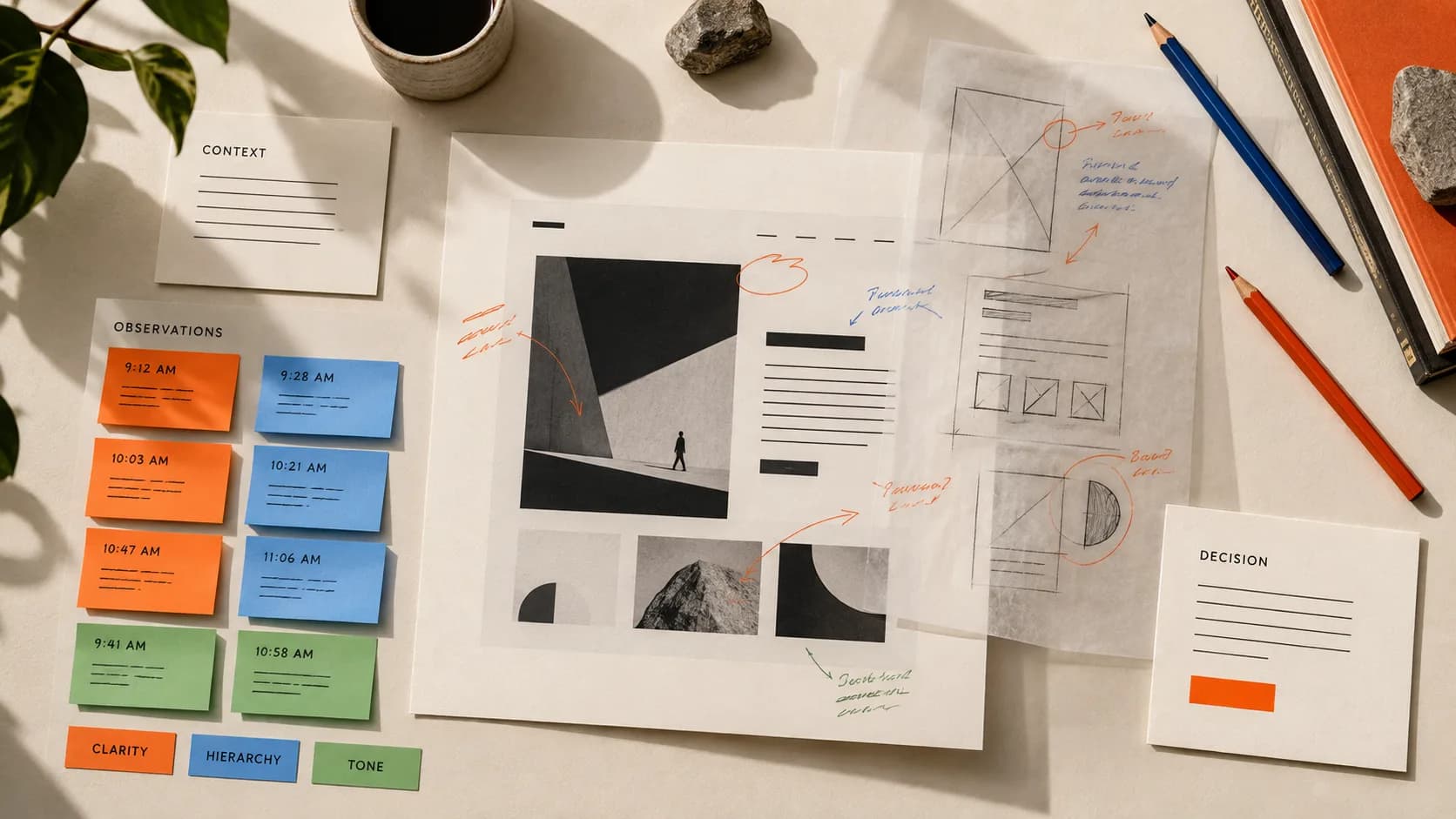
The short answer: remote critique is a system, not a video call
A remote critique does not become useful because everyone can see the same screen. It becomes useful when people know what they are looking at, what question matters, how to contribute, and what will happen to their feedback.
Distance can make weak habits more visible: vague invitations, rushed reactions, comments without context, meetings that end without a decision. It can also improve the work. Independent review reduces anchoring. Written observations create a record. A hybrid format can reserve live time for the disagreements and tradeoffs that actually need conversation.
Choose the format by the question
“Remote” describes where people are. It does not tell you whether the critique should happen together, separately, or in stages. Match the format to the kind of thinking you need.
When each format earns its place
- Use async review
- When the artifact is concrete and people need time to inspect it independently.Useful for hierarchy, content, flow details, consistency, and feedback across schedules or time zones.
- Use a live critique
- When the team needs clarification, comparison, negotiation, or a decision.Useful for competing directions, consequential tradeoffs, unclear constraints, and feedback that depends on dialogue.
- Use a hybrid loop
- When independent observations matter and the team still needs to align.Collect a quiet first read, cluster the real tensions, then use live time only for the decisions that remain open.
- Skip the critique
- When the work only needs approval, a factual answer, user research, or an implementation review.Naming the actual meeting prevents a critique from becoming disguised sign-off or unfocused opinion gathering.
Format-first planning
“Let’s put 45 minutes on the calendar.”
Question-first planning
“We need to choose which hierarchy supports this task.”
Write the brief before you ask for feedback
A link with “thoughts?” transfers the framing work to every reviewer. A useful brief is short, but it gives everyone the same starting point and protects the critique from turning into a tour of personal preferences.
The minimum useful critique brief
- Artifact: the exact screen, flow, prototype, document, or direction being reviewed.
- Audience and task: who this is for and what they are trying to do.
- Stage: what is exploratory, what is decided, and what is still inexpensive to change.
- Question: the one or two decisions where another perspective will help.
- Evidence: research, requirements, content, technical conditions, or prior decisions that should inform the read.
- Boundaries: what is outside scope and when feedback is needed.
Run an async critique in five moves
Async critique works when it is bounded. People need a clear window, a stable artifact, and a place where the decision will be recorded. Otherwise comments arrive after the work has moved on and nobody knows which version they describe.
- 1Post the brief with one source of truth.Link the exact version, name the question and deadline, and say where the response will be summarized.
- 2Ask for an independent first read.Let reviewers inspect before they see a thread full of other opinions. Private notes or a short silent window can reduce anchoring.
- 3Attach comments to evidence.Point to the visible element, state, content, or moment in the flow. Separate an observation from the interpretation or proposed fix.
- 4Cluster rather than count.Group comments by the decision or user task. Repetition can signal friction, but volume alone does not make a comment correct.
- 5Publish the response.State what will change, what needs another test, what stays, and what falls outside this pass.
Use live time for interaction, not presentation theater
Send enough context in advance that the meeting can begin with the question. A short walkthrough may still be necessary, but it should not consume the time needed to inspect, compare, and decide.
- 1Restate the scope.Name the decision, the timebox, and what is not being reviewed today.
- 2Begin with quiet observation.Give everyone a few minutes to inspect and write before the discussion. This creates room for more than the fastest voice.
- 3Invite perspectives deliberately.Use a round, written share, or direct invitation when the same people tend to dominate. Do not confuse silence with agreement.
- 4Return comments to the objective.Ask what in the work supports the concern and how it affects the intended task. Park unrelated issues instead of debating everything.
- 5Close with a decision readback.Say what you heard, what happens next, who owns it, and which question remains unresolved.
Government design teams that adapted critique for remote work report practical moves rather than a universal formula: share material in advance, shorten or split sessions, add facilitator prompts, keep the joining path simple, and leave space for independent reflection.
A hybrid loop is often the most useful default
Hybrid does not mean duplicating the whole critique twice. It means giving each mode one job: async for seeing and live for sensemaking.
A compact hybrid sequence
- Before
- Share the brief and artifact; ask for independent observations by a real deadline.
- Between
- Cluster the feedback and select the two or three tensions that require conversation.
- Together
- Discuss only the open decisions, compare evidence, and make the tradeoff visible.
- After
- Post the decision, owner, next change or test, and what was deliberately deferred.
Repair the failure mode you actually have
Most remote-critique problems are not solved by changing tools. They come from a missing frame, unclear role, or broken follow-through.
When the critique is not working
- You get “looks good”
- Replace the open invitation with one decision question and name the user task behind it.
- Comments contradict each other
- Surface the different assumptions. Ask which objective, evidence, or constraint should decide the tradeoff.
- One person sets the direction
- Collect a quiet first read, rotate facilitation, and invite relevant perspectives before opening the floor.
- Feedback arrives too late
- Define a smaller review window and state what will be decided when it closes.
- Nothing changes
- Publish the response to feedback. Show change, investigate, keep, and outside-scope decisions with owners.
- The call feels exhausting
- Move context and first observations async; shorten the live session to the unresolved questions.
Use AI to prepare the conversation, not impersonate the team
An independent AI read can be useful before a remote critique: it can identify a visible hierarchy problem, question an assumption, or give the designer language for something that feels off. That is preparation, not consensus and not validation.
Too much authority
“The AI says this is the problem.”
Useful input
“This first read noticed a hierarchy risk. Does that match what we see?”
The critique is not complete until people know what happened
The most human follow-through is simple: show that the feedback was heard and judged. You do not need to implement every comment. You do need to make the response legible.
End with four buckets
- Change now: the evidence is clear and the revision belongs in this pass.
- Investigate or test: the concern is plausible but needs more information.
- Keep as-is: the current choice still fits the goal; record the reason.
- Outside scope: useful or not, the comment does not belong to this decision.
Nielsen Norman Group’s 2026 follow-up guidance makes the same point: an immediate recap tells people what was heard and what happens next; a later follow-up connects the evolved design back to the critique. That closure builds trust in the process.
If the team needs a broader foundation, start with what a design critique is. If the problem is the distinction between improvement and approval, use the critique versus review guide.
Sources and practice references
- Nielsen Norman Group: Design Critiques for scope, objectives, facilitation, documentation, and follow-through.
- Nielsen Norman Group: Closing the Loop After a Design Critique for immediate recaps and later design follow-up.
- UK Government Design Notes: weekly remote Get Feedback sessions for a structured remote format centered on safety, context, and useful feedback.
- Home Office Digital: Running Our First Remote Design Crit for advance material, facilitator prompts, shorter sessions, simple communication, and reflection.
- Department for Education: Reviews and Content Crits for the minimum context, requested feedback, and delivery method in a critique invitation.
QuestionsAnswers
Questions, answered.
A few practical details before you keep going
Share this resource

Written by
Nikki KippleProduct Designer & Design Instructor
Designer, educator, founder of The Crit. I've spent years teaching interaction design and reviewing hundreds of student portfolios. Good feedback shouldn't require being enrolled in my class — so I built a tool that gives it to everyone. Connect on LinkedIn →
Give the next critique something concrete to discuss
Share the current artifact and the question behind it. We will identify one visible priority and explain the evidence—useful input for your next async or live critique, not a replacement for the team.