What Your Portfolio Tagline Needs to Do
Your portfolio tagline (also called a hero headline or personal brand statement) sits at the top of the homepage. It is one of the first clues a visitor gets about what kind of designer you are and what they should look at next.
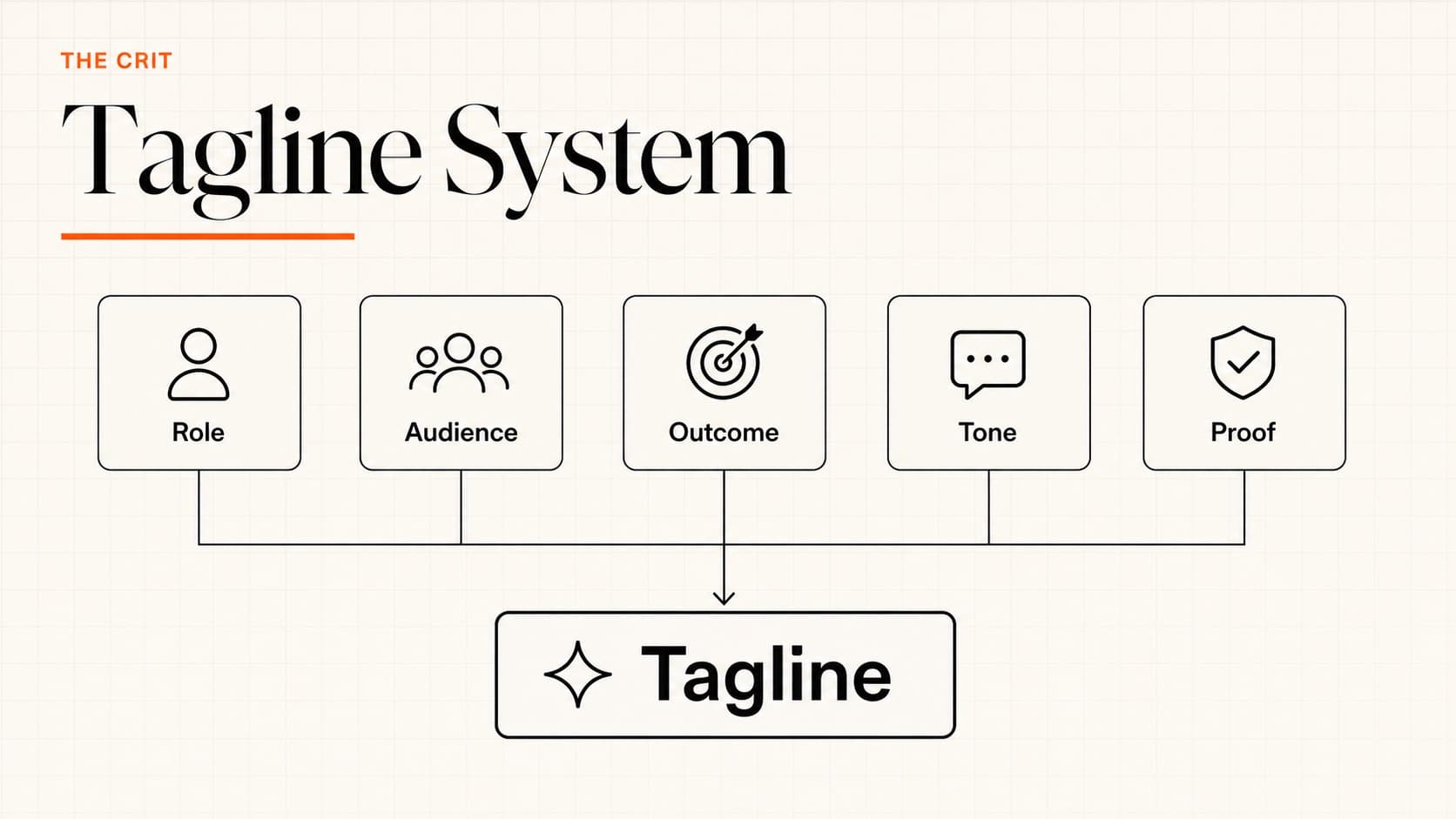
A useful tagline usually answers some combination of who you are, what you do, and why it matters. It does not need to do all three perfectly. It needs to make the rest of the portfolio easier to understand.
The strongest headlines tend to be clear and specific. They name a specialty, an audience, a kind of problem, or an outcome—and the work underneath gives the claim credibility.
Your tagline works together with other key elements of your portfolio. Once you nail your headline, make sure your project selection and case study structure support the same narrative.
20 Tagline Patterns to Adapt
These are illustrative examples written for this guide. They are not quotes from real designers, and they do not imply a hiring result. Use the pattern that fits your work, then rewrite it in your own voice.
Brand transformation
“Helping small brands look ready for their next stage”
Names the audience and the change the work supports.
Visual storytelling
“Turning complicated stories into identities people remember”
Connects the craft to a clear reader outcome.
UX + personality
“Clearer product experiences, without sanding off the personality”
Pairs a practical benefit with a point of view.
Complex to simple
“I turn complicated workflows into products people can use”
Makes the kind of problem and the intended result easy to understand.
Irreverent voice
“Digital products that don't make people work so hard”
Shows personality while still making a useful promise.
Three-part identity
“Systems thinker. Typography person. User advocate.”
A compact structure for a designer with three connected strengths.
Direct outcome
“I make mobile apps easier to understand and use”
Plain language can be more convincing than a clever phrase.
Beauty + function
“Making useful products feel considered”
A restrained way to signal attention to both function and craft.
Industry-specific trust
“Helping fintech startups earn trust through product design”
Specific audience, specific business need, specific discipline.
Motion transformation
“Motion design that gives static brands a pulse”
Shows the before-and-after effect of the specialty.
Research impact
“Research that changes what the product team does next”
Focuses on what happens after the research.
B2B specialization
“Design strategy for B2B software teams”
Simple positioning can work when the niche is already specific.
Design + code
“A frontend developer who notices the design details”
Frames the overlap between two disciplines as an advantage.
Accessibility first
“Accessibility-first UX for everyday products”
Names the principle and the kind of work it applies to.
Data-informed design
“Product design that can talk to the numbers”
Signals comfort with evidence without claiming design is purely objective.
Inclusive experiences
“Designing digital experiences more people can use”
Keeps the value concrete and focused on people.
Values-aligned work
“Brand design for companies building something worthwhile”
A point of view that can help attract aligned clients.
Zero-to-one focus
“0→1 product design for early-stage teams”
Names the company stage and the kind of design work.
Healthcare systems niche
“Service design for complicated healthcare systems”
Positions the designer around a difficult, recognizable problem space.
Clarity in a complex category
“Making crypto products a little less confusing”
A modest, believable promise with some personality.
5 Useful Tagline Formulas
Can't think of a tagline? Use one of these structures as a starting point, then make the language specific to your work.
- 1[Action] + [Target] + [Outcome]“Crafting digital experiences that convert visitors into customers”When to use: You want to show direct business impact
- 2[Skill/Role] + [Unique Angle]“Product Designer with a developer's mindset”When to use: You have a unique background or approach
- 3[Problem] → [Solution]“Turning messy data into clear stories”When to use: You're positioning as a problem-solver
- 4Three-part list“Researcher. Designer. Storyteller.”When to use: You wear multiple hats equally well
- 5Bold statement“Your users deserve better. I can help.”When to use: You want to stand out and show confidence
You wrote the line. Now see how the whole hero reads.
Paste your portfolio URL or upload the hero. The First Read checks whether the positioning, hierarchy, and work support the promise—not just whether the sentence sounds clever.
Want to see the full criteria first? Here's what the critique checks.
Tagline vs Bio vs Headline: What Goes Where
Designers often confuse these three things. They serve different purposes and show up in different places. Getting the distinction right means your messaging is consistent without being repetitive.
- Portfolio tagline
- A short opening promise that helps the reader interpret the work.“Making healthcare apps people actually understand.”
- Professional bio
- A few sentences of context, experience, and personality.Explain how you arrived at the work and what you care about.
- LinkedIn headline
- A searchable description of your role and relevant specialties.Use the words people looking for that work are likely to recognize.
The tagline is your hook. The bio is your story. The LinkedIn headline is your search optimization. They should all point in the same direction — same specialty, same value proposition — but in different formats. For a deeper dive into building a cohesive portfolio narrative, check our complete portfolio guide.
Taglines by Career Stage
Your tagline should match where you are in your career. What works for a senior designer sounds hollow from a junior, and vice versa.
Junior / Career Changer
Focus on your perspective, your energy, and what you're building toward. Don't pretend to have experience you don't have — own the fresh eyes you bring.
“Former nurse turned UX designer — I bring patient empathy to every interface.”
“Building my first 10 products. Learning fast.”
“Design student obsessed with accessible mobile experiences.”
Mid-Level (2-5 years)
You have enough work to show a pattern. Lead with your specialty and the kind of problems you solve.
“I design checkout flows that actually convert.”
“Product designer for B2B tools that don't need a manual.”
“Making enterprise software feel like consumer apps.”
Senior / Lead
At this level, you can claim expertise and scope. Talk about impact, systems, and the scale of problems you tackle.
“Design leader scaling product teams from 0 to 50.”
“Building design systems that ship faster and break less.”
“I help companies figure out what to build next.”
Notice how each level emphasizes different things: juniors show perspective and potential, mid-levels show specialty and outcomes, seniors show leadership and strategic impact. Not sure how your overall portfolio reads? A portfolio critique can help you see it through a recruiter's eyes.
Testing & Iterating Your Tagline
A tagline can get clearer as your work and direction change. Here are a few lightweight ways to compare versions without pretending one sentence determines conversion on its own.
Need more help crafting your initial versions? Check out our comprehensive tagline writing guide for detailed frameworks and exercises.
Try three genuinely different angles
- Direct value
- “Helping fintech startups build user trust through design”Focus on what you do for clients or companies.
- Problem and solution
- “Making complex financial apps actually usable”Lead with a pain point you solve.
- Personality and skill
- “Design systems nerd who loves solving messy UX problems”Show both expertise and character.
Quick testing methods
- Five-second read: Show the hero briefly, then ask what kind of work they expected to see.
- Audience check: Ask a few people in the intended audience what each version means to them.
- Portfolio behavior: Look for directional changes in project clicks, not a single bounce-rate verdict.
- Message consistency: Check that the headline, project selection, About page, and outreach tell the same story.
Signs the positioning is clearer
- People ask useful follow-up questions instead of only saying “cool.”
- People describe your focus in language close to what you intended.
- The projects they open support the promise in the headline.
- The opportunities that reach you fit the specialty you named.
4 Tagline Mistakes That Kill Your Chances
Avoid these common mistakes that make taglines forgettable (or worse, laughable).
Too generic
Too generic
“Passionate designer creating beautiful designs”
More specific
“Mobile designer specializing in fintech apps”
Buzzword overload
Too generic
“Innovative, synergistic design solutions leveraging cutting-edge methodologies”
More specific
“I design apps that people understand in seconds”
No clear audience
Too generic
“Designer for everyone”
More specific
“Helping startups build their first product”
All about you
Too generic
“Award-winning designer with 10 years experience”
More specific